Separating organic materials from the trash should be thought of as a resource, not a waste. In Connecticut, food scraps make up about one of every five pounds of garbage, according to a 2015 study published by the state Department of Energy and Environmental Protection. More food reaches landfills and incinerators than any other single material in our everyday trash. Composting reduces the waste going to out of state landfills but can also reduce your household garbage. Compost added to gardens, construction sites, and poor soils makes great things happen!
We hope that you will join us in the effort to prevent food waste from entering the conventional waste stream and promote a sustainable environment!
Want to join the Transfer Station program?
Are you interested in separating your food scraps from your trash so it can be made into compost, but don’t want to do it in your back yard? Here’s everything you need to know to participate in the Newtown food scraps recycling program at the Transfer Station. Click on the topics below for more information.
How does the program work?
There is no fee for residents to drop-off food waste and/or acceptable organics. A transfer station permit is required to access Newtown’s facility. FREE permits must be obtained in person at the Transfer Station.
It is very important that participants bring ONLY acceptable items. The full list of acceptable items is in the next drop-down menu.
Participants simply dump their own container out into a designated collection bin at the TRANSFER STATION located at 4 Ethan Allen Road, Newtown.
IMPORTANT – Please DO NOT contaminate the compost. Remove plastic ties, stickers, twist ties and DO NOT use plastic bags. It’s important to note that contaminated material cannot be processed into compost. It will be disposed of as MSW (Municipal Solid Waste aka trash) and sent to a waste-to-energy plant, which adds cost to the program.
Compost will be available to residents in the spring.
Acceptable waste items
REMEMBER – ONLY FOOD Scraps are allowed in your bin.
No PLASTIC items, stickers, rubber bands or twist ties!
- Houseplants & Flower Bouquets
- Flower & Vegetable Garden Clippings
- Fruits & Nuts (including pits)
- Vegetables ***Remove stickers, bands and ties***
- Bread, Pasta & Grains
- Sauces, Soup & Gravy
- Coffee Grounds & Filters
- Tea Bags
- Egg Shells
- Meats & Poultry (including bones)
- Dairy Products
- Fish & Shellfish
- Plate Scrapings
- Spoiled food
- Fridge leftovers
- Paper Towels & Napkins (free of cleaning products)
PLEASE DO NOT include any packaging, take-out containers, compostable bags/utensils, etc.
Items that say "compostable"?
For the success of our program we are asking residents to stick to our published list of acceptable items (see below). Even though companies can label and market their products as “compostable” or “compostable in a commercial facility” they may not actually be compostable or accepted by the composting facility. For these reasons and more, please leave them out of the program.
Collection Container
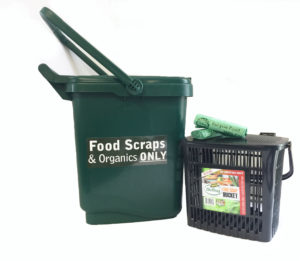
You may collect your food scraps and organic waste in your own bucket such as a 5-gallon pail. Or you may pick up at collection kit and be added to the list of participants at Newtown Public Works. The collection kit consists of a 1.5-gallon kitchen bin, 2 rolls of compostable bags (25 bags total) and 6-gallon Eco-Caddy with
lock-lid.
Additional biobags are also available at Newtown Public Works and the Newtown Transfer station.
What happens to my food scraps?
Newtown has created a self-sustaining closed loop Aerated Static Pile (ASP) composting system for transforming residential food waste into an end-product for community use. Your food scraps are going directly to the Newtown ASP composting system on site at the Transfer Station.
This innovative project demonstrates that municipalities can manage food waste locally, reduce the carbon footprint of offsite disposal, minimize transportation costs and contribute to the waste diversion goals of the state.
Want to join the Smart Bin program?
These smart bins have been located in Newtown to provide more options for dropping off food scraps. The purpose is to create easy and convenient opportunities for residents to participate in reducing their waste, by removing food scraps.
Follow these steps to join the program.
How does the program work?
There is no fee for residents to drop-off food waste and/or acceptable organics at the Smart Bins.
It is very important that participants bring ONLY acceptable items. The full list of acceptable items is below.
If you have a Newtown Transfer Station permit you still have access to dropping off food scraps at the Transfer Station as well as any Smart Bin.
IMPORTANT – Please DO NOT contaminate the compost. Remove plastic ties, stickers, twist ties and DO NOT use plastic bags. It’s important to note that contaminated material cannot be processed into compost. It will be disposed of as MSW (Municipal Solid Waste aka trash) and sent to a waste-to-energy plant, which adds cost to the program.
Compost will be available to residents in the spring.
Download the App
Download the MetroKEY App – Click Here for links
Drop Off
Take your scraps to a Newtown Smart Bin
- Newtown Senior Center – 8 Primrose Street
- Dodgingtown Fire House – 55 Dodgingtown Road
- Sandy Hook Firehouse Sub-Station – 249 Berkshire Road
- Hawleyville Fire Station – 34 Hawleyville Road
Acceptable waste items
REMEMBER – ONLY the items listed below are allowed in your bin.
No PLASTIC items, stickers, rubber bands or twist ties!
- Houseplants & Flower Bouquets
- Flower & Vegetable Garden Clippings
- Fruits & Nuts (including pits)
- Vegetables ***Remove stickers, bands and ties***
- Bread, Pasta & Grains
- Sauces, Soup & Gravy
- Coffee Grounds & Filters
- Tea Bags
- Egg Shells
- Meats & Poultry (including bones)
- Dairy Products
- Fish & Shellfish
- Plate Scrapings
- Spoiled food
- Fridge leftovers
- Brown Napkins & Brown Paper Towels (*Free of cleaning products)
PLEASE DO NOT include any packaging, take-out containers, compostable bags/utensils, etc.
Items that say "compostable"?
For the success of our program we are asking residents to stick to our published list of acceptable items (see below). Even though companies can label and market their products as “compostable” or “compostable in a commercial facility” they may not actually be compostable or accepted by the composting facility. For these reasons and more, please leave them out of the program.
What happens to my food scraps?
Newtown has created a self-sustaining closed loop Aerated Static Pile (ASP) composting system for transforming residential food waste into an end-product for community use. Your food scraps are going directly to the Newtown ASP composting system on site at the Transfer Station.
This innovative project demonstrates that municipalities can manage food waste locally, reduce the carbon footprint of offsite disposal, minimize transportation costs and contribute to the waste diversion goals of the state.
What is the Food Scraps Recycling Program?
The Town of Newtown is providing residents the opportunity to reduce their waste and recycle their food scraps through this food scraps recycling program.
Why should I compost?
The study found that composting organic waste versus landfilling it can reduce more than 50% of carbon dioxide-equivalent greenhouse gas emissions, for a total of 2.1 gigatons between now (2020) and 2050 if climate change is curbed to a 2 degree Celsius rise in the average global temperature. However the emission savings from landfill diversion is only one benefit of composting. Click Here to read more about the study
Separating your food scraps for compost is easy and provides many benefits, some of which are listed below:
- Since food waste on average makes up 24% of the waste stream and is often the heaviest material in your trash, reducing the weight by composting will also save you money.
- Compost is beneficial to the environment. It is a unique soil amendment because of its ability to hold moisture and soluble minerals.
Composted organics are beneficial, because they:
-
- Maximize plant growth.
- Effective at preventing soil erosion.
- Aid in Stream and land reclamation.
- Reconstruction of wetlands.
- Help with storm water management.
- Reduces the need for fertilizers.
- Reduces the need for pesticides.
- Improves the over all health of soil.
Resources
Using compostable bags
The compostable bags provided are for your convenience and are meant to help eliminate the yuck factor. You do not have to use the compostable bags and we welcome individuals who wish to use just their containers to collect waste.
If you do choose to use compostable bags, you are required to use only bags approved by the program. At this time Biobags are the only approved and certified compostable bags we will accept. If you wish to purchase your own supply you can find them online from many retailers.
PLEASE NOTE, compostable bags are meant to break down. They do have a shelf life. We do not recommend buying in bulk unless you are planning to share and or use them within their recommended shelf life which is approximately one year.
What is an ASP Composting Process?
The “Aerated Static Pile (ASP) Composting” process uses a 1.5 horsepower blower that is set to a timer. The timer will run at designated intervals. The blower will be connected to rigid and flexible perforated piping that will push air through the composting pile. This will allow us to maintain proper moisture and oxygen levels. It is important to maintain proper airflow for the microbial population, that breaks down the organic matter.
Learn more about ASP Systems and Composting Here