Separating organic materials from the trash should be thought of as a resource, not a waste. In Connecticut, food scraps make up about one of every five pounds of garbage, according to a 2015 study published by the state Department of Energy and Environmental Protection. More food reaches landfills and incinerators than any other single material in our everyday trash. Composting reduces the waste going to out of state landfills but can also reduce your household garbage.
We hope that you will join the effort to prevent food waste from entering the conventional waste stream and promote a sustainable environment!
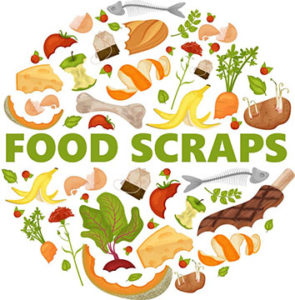
What is the Food Scraps Program?
How does the program work?
The City of Danbury has installed an Organics (food scraps) Smart Bin at the PAL Center (35 Hayestown Road). The purpose of the smart bin is to create easy and convenient opportunities for residents to participate in reducing their waste, by removing food scraps from their regular trash.
It’s simple to participate in three easy steps.
1.) Sign-up for the City of Danbury food scraps recycling program, click here. The cost to participate is $20.
2.) Download the “MetroKEY” phone app via Apple or Google
3.) Bring your food scraps to the bin. (Just food scraps are accepted in the bins)
The mobile app activated satellite container is available to deposit food scraps (ONLY) at your convenience 24/7 at the PAL Center (35 Hayestown Road).
Acceptable waste items
REMEMBER – ONLY FOOD Scraps are allowed in your bin.
No PLASTIC items, stickers, rubber bands or twist ties!
- Houseplants & Flower Bouquets
- Flower & Vegetable Garden Clippings
- Fruits & Nuts (including pits)
- Vegetables ***Remove stickers, bands and ties***
- Bread, Pasta & Grains
- Sauces, Soup & Gravy
- Coffee Grounds & Filters
- Tea Bags
- Egg Shells
- Meats & Poultry (including bones)
- Dairy Products
- Fish & Shellfish
- Plate Scrapings
- Spoiled food
- Fridge leftovers
- Paper Towels & Napkins (free of cleaning products)
PLEASE DO NOT include any packaging, take-out containers, compostable bags/utensils, etc.
Can I add items that say "compostable"?
For the success of our program we are asking residents to stick to our published list of acceptable items (see left). Even though companies can label and market their products as “compostable” or “compostable in a commercial facility” they may not actually be compostable or accepted by the composting facility. For these reasons and more, please leave them out of the program.
Collection Container
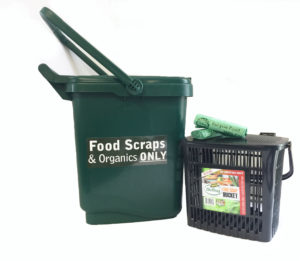
You may collect your food scraps and organic waste in your own bucket such as a 5-gallon pail.
The start kit includes a 6-gallon carry container, 1.5 gallon black kitchen counter collection bins and compostable bags Shown here to the left.
Join the Smart Bin Program
Step 1: Sign Up
Click here to sign-up for the Danbury Smart Bin Program
Step 2: Download the App
Step 3: Drop Off Locations
Take your scraps to:
- Danbury PAL – 35 Hayestown Road
- Richter Park on Aunt Hack Road
- King Street Volunteer Fire House on South King Street
- Mill Plain Green in front of 65 Mill Plain Road
- War Memorial parking lot in Rogers Park
Other Resources
Why should I compost?
The study found that composting organic waste versus landfilling it can reduce more than 50% of carbon dioxide-equivalent greenhouse gas emissions, for a total of 2.1 gigatons between now (2020) and 2050 if climate change is curbed to a 2 degree Celsius rise in the average global temperature. However the emission savings from landfill diversion is only one benefit of composting. Click Here to read more about the study
Separating your food scraps for compost is easy and provides many benefits, some of which are listed below:
- Since food waste on average makes up 24% of the waste stream and is often the heaviest material in your trash, reducing the weight by composting will also save you money.
- Compost is beneficial to the environment. It is a unique soil amendment because of its ability to hold moisture and soluble minerals.
Composted organics are beneficial, because they:
-
- Maximize plant growth.
- Effective at preventing soil erosion.
- Aid in Stream and land reclamation.
- Reconstruction of wetlands.
- Help with storm water management.
- Reduces the need for fertilizers.
- Reduces the need for pesticides.
- Improves the over all health of soil.
Resources
Using compostable biobags
The compostable bags that are provided in your collection kit are for your convenience and are meant to help eliminate the yuck factor. You do not have to use the compostable bags and we welcome individuals who wish to use just their containers to collect waste.
If you do choose to use compostable bags, you are required to use only bags approved by the program. At this time Biobags are the only approved and certified compostable bags we will accept. If you wish to purchase your own supply you can find them online from many retailers.
PLEASE NOTE, compostable bags are meant to break down. They do have a shelf life. We do not recommend buying in bulk unless you are planning to share and or use them within their recommended shelf life which is approximately one year.